Ulm, Germany · Est 2022

Built by hand.
Built to last.
Built for those who know why.

A small workshop in Germany. One person. One guitar at a time. Ready when ready.
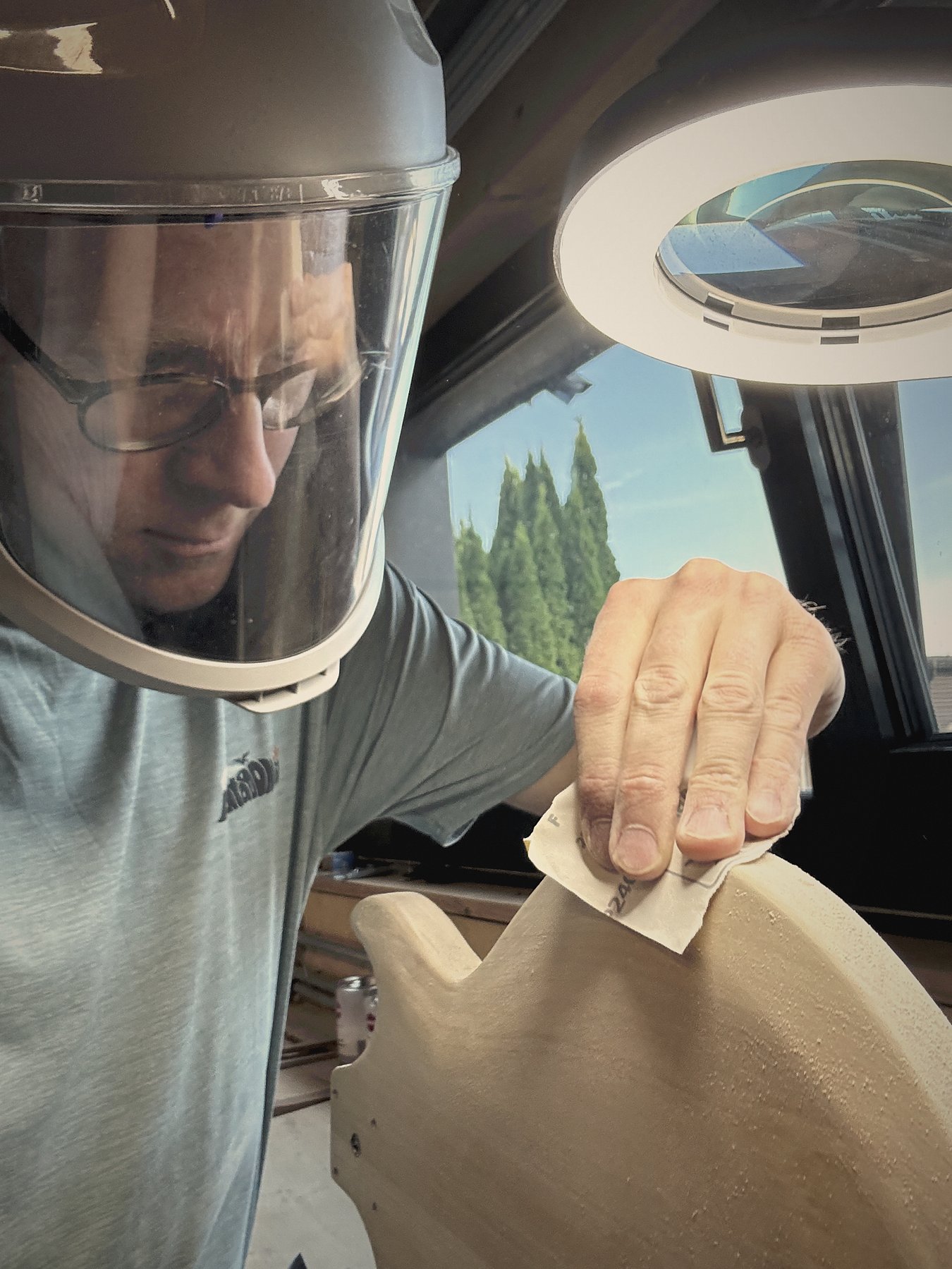
§ 01 — Workshop One person, one guitar at a time
At the workbench, full-face respirator on, light low
— § 01 / Workshop

A workshop, not a brand.

Nirvana got me into electric guitars when I was a teenager. My first electric guitar was a Squier Affinity Stratocaster in Olympic White. It endured countless modifications and has seen many stages with my former band. Along the way I bought, played, dismantled and upgraded many guitars — including vintage and boutique guitars.

Guitar making is, to borrow the Japanese word, my ikigai.

For me this is a quiet workshop. Safety, health, and calm come first — always. The full-face respirator goes on before the dust does.

— § 01.1 / Material

The wood is where it begins.

I buy air-dried wood from old stocks, some of it aged for decades — and some of it I cut myself. From very rare wood according to old specs to locally grown alternatives like plum, alder and maple, I carefully select every piece. I enjoy bringing to life what has already been there, hidden in the grain.

— § 01.2 / Build

Then the manual work to unlock the material's potential.

Routing, chambering, profiling, fretboard preparation, fret work. Each step measured before, during and after. No CNC, no jig that I haven't built or chosen myself. The patience of metalworking, applied to wood. Stains, oils, hand-rubbed shellac — all done in this workshop. Only the nitrocellulose lacquer step, when a build calls for it, goes to a partner workshop ten minutes from here, equipped with the latest environmental and safety technology.

"It will be ready when it is ready."
— A working principle, borrowed openly from Howard Alexander Dumble.
§ 02 — Legends Two exemplary studies. Read from the inside out.
— § 02 / Legends

Improving means you know what needs to be done differently.

Two exemplary studies. One pair of 1969 Stratocasters, taken apart and measured. One pair of cabinets by the late Kerry Wright, owned, opened, and understood from the inside out. Everything I do at Torka begins with what these instruments taught me.

— § 02.1 / Study one

Two 1969 Stratocasters.

Same year. Same factory. Same kind of money, around twenty thousand euros each. I took both of them apart, measured every dimension, photographed every joint.

One of them plays well — it is a real player. The other does not, and probably never did.

The difference is not the old wood. Old wood is voodoo, mostly — a story we tell ourselves about why old guitars sound and feel the way they do. The real difference is in the work: how tightly the neck sits in the pocket. How the fretboard edge feels under the hand. How the lacquer aged and reacts. How the back of the neck is finished and, quite importantly, what type of pickups are used and how they are set up. These are the things I carry into every Torka build.

I considered buying a pre-CBS Strat for myself. I decided not to, and built one instead — to old specs, with the best wood and tools I could get my hands on, and the kind of patience the work demands. Right decision.

— Finding 01

Neck pocket fit decides almost everything. A fraction of a millimetre of slop, and the guitar loses its voice.

— Finding 02

The fretboard edge wants to be rolled. Slightly. By hand. It is the difference between a tool and an instrument.

— Finding 03

The back of the neck should not be a slick finish. Skin and wood should know each other directly.

— Finding 04

Tolerances on a 1969 body are not what the legend suggests. They are what good people, working carefully, can do. Nothing more.

— § 02.2 / Study two

Cabinets by Kerry Wright.

The late Kerry Wright built some of the most musically transparent guitar cabinets ever made. Quiet legends among studio engineers and discerning players. I own originals. I have measured them — joint by joint, dimension by dimension, board thickness by board thickness.

What looks simple from the outside is, on inspection, a careful act of acoustic restraint. What you do not put inside the cabinet matters as much as what you do. Where you screw and where you glue. How the baffle sits in the frame.

The cabinets I build are not Kerry Wright cabinets. They are Torka cabinets, built to those measurements, in honour of his work — and they let me give players the cabinet voice I myself wanted.

§ 03 — Logbook Instruments and cabinets, built by hand
— § 03 / Logbook

From this workshop.

Selected pieces from recent builds.

Each guitar carries a small nickel-silver medallion on the back of the headstock and comes with a certificate of authenticity that records the materials used, hardware, finishes, electronics and date. The medallion is engraved with my signature only when the instrument is complete, then set into the neck plate on the back. Cabinets carry a small plate on the back and come with a certificate as well. These are small details, visible for the ones who know what they have. Others will not notice.

— § 03.1 / Guitars

Electric guitars.

— Prototype · for family

S-style · Sherwood Green.

The first one I built end-to-end, and the one I learned on. My wife picked the colour — a dark Sherwood Green — and the gold hardware to match. Christmas gift to our daughters. There's a signature and a message behind the neck plate. Stays in the family.
S-style in Sherwood Green, gold hardware, flame maple headstock — front
S-style in Sherwood Green — back, flame maple neck, gold neck plate
Specifications Hardtail · 4-piece body, 12-yr air-dried German alder, quarter sawn · AAAA maple neck, quarter sawn · Rosewood fingerboard, 9.5″ radius · Fender Vintage bridge · 3× CTS 250 kΩ custom split-shaft pots · CRL 5-way switch · Switchcraft input jack · Vitamin-T oil-filled .047 µF capacitor · Fender Vintage tuners · Fender Pure Vintage 1961 pickups · Vintage nitro finish · Gold hardware · Schaller security locks · NOS
— Build · for Lennard

S-style · Pelham Blue.

Pelham Blue with gold hardware — the owner's call. Neck profile sits between a C and a U: not too thin, not too thick, oiled on the back. Fingerboard edges rolled, so it plays like it has had decades of use.
S-style in Pelham Blue, gold hardware, flame maple headstock — front
S-style in Pelham Blue — back, gold neck plate, serial 0003
Specifications Hardtail · 2-piece body, air-dried US American alder · AAAA maple neck, quarter sawn · Rosewood fingerboard, 9.5″ radius · 3× CTS 250 kΩ custom split-shaft pots · CRL 5-way switch · Switchcraft input jack · Vitamin-T oil-filled .047 µF capacitor · Fender Vintage tuners · Fender Pure Vintage 1961 pickups · Vintage nitro finish · Gold hardware · Neck partially finished with vintage nitro · NOS
— Build no. 0001 · for Matthias Freund, Ulm

S-style · Black Gloss.

Built for Matthias Freund, a musician here in Ulm. He has owned many guitars and never stopped looking for the final one. I offered to build it in the spirit of pre-CBS, and shaped the neck to fit his hand. It has been his go-to ever since, and I see it on stages around town.
S-style in Black Gloss, mint pickguard, flame maple neck — front
S-style in Black Gloss — back, partially lacquered neck, neck plate engraved 0001
Specifications Build no. 0001 · Hardtail · 3-piece body, 12-year air-dried German alder, quarter sawn · AAAA maple neck, quarter sawn · Rosewood fingerboard, 7.25″ vintage radius · Fender Vintage bridge · 3× CTS 250 kΩ custom split-shaft pots · CRL 5-way switch · Switchcraft input jack · Vitamin-T oil-filled .047 µF capacitor · Fender Vintage road-worn tuners · Fender Pure Vintage 1961 pickups · Vintage nitro finish · Partially lacquered neck · NOS
— Build · for Nick

T-style · flamed maple top, mahogany body.

Built for Nick, who came to me without a fixed picture of what he wanted. I sent him photos through the build so he could watch it take shape. The combination of Häussel P90s with the old mahogany works well. I won't repeat this exact build — every instrument is its own — but the recipe goes into the notebook.
T-style with flame maple top over mahogany, two P90s — front
T-style — back, mahogany body and neck
Specifications Hardtail · 1-piece old-stock mahogany body, chambered, neck from same piece of old-stock mahogany · AAA maple top · Malaysian Blackwood fingerboard, 9.5″ radius · Babicz bridge · 3× CTS 250 kΩ custom split-shaft pots · CRL 3-way switch · Switchcraft input jack · Orange Drop capacitor · Fender Vintage road-worn tuners · Häussel P90 pickups with aged nickel covers · Oil finish · NOS
— § 03.2 / Cabinets

Speaker cabinets.

— Cabinet · 2×12 diagonal

Black · 2×12.

Built to complement a 2023 Two-Rock Studio Signature head. Two G12-65 speakers, three-dimensional sound with a hi-fi character. The finish was chosen to sit alongside the head, which was hand-built in California.
2×12 black cabinet, chrome corners — front
2×12 black cabinet — back, twin G12-65 speakers
— Cabinet · 1×12

Black · 1×12.

Built to complement a 2025 Two-Rock Studio Signature head. Eminence Cannabis Rex 12″ inside, picked for the smooth clean voice the owner wanted — well suited to jazz and blues.
1×12 black cabinet, chrome corners — front
1×12 black cabinet — back, Eminence Cannabis Rex speaker
— Cabinet · 2×12 diagonal

Emerald Green · 2×12.

Built for a professional musician and guitar teacher to run with his 6L6-powered Morgan. On stage shortly after delivery — the Marshall-style vintage tolex paired with the black diamond cloth (the same kind that shows up on Dumble heads) reads differently from anything else on the floor. Worth noting: Kerry Wright also built cabinets for Howard Alexander Dumble.
2×12 Emerald Green cabinet, diamond grille — front
2×12 Emerald Green cabinet — back, twin Warehouse G12C/S speakers
— Cabinet · 1×12

Emerald Green · 1×12.

Built for a player who came back to electric guitar after years on acoustic, and added a Two-Rock head along the way. Inside is an Alessandro 12″. I first heard one in a 12″ F-style Dumble combo where the original speaker had been swapped out — when someone makes that change to a 50k-plus amp, the choice carries weight. The sound bears it out.
1×12 Emerald Green cabinet — front
1×12 Emerald Green cabinet — back, Alessandro GA-SC64 speaker
Not affiliated with, endorsed by, or successors to Kerry Wright. Built independently, to the measurements of original cabinets in personal possession, as a tribute to his craft.
§ 04 — Contact By letter, not form
— § 04 / Contact

Write a letter, not a form.

There is no contact form on this site, by design. If you have a guitar in mind, write directly. Tell me what you play, what you want, what you don't want, and what you are willing to wait for.

I read every message myself. I do not always say yes.

[email loading…]